Showing posts with label French design. Show all posts

Tuesday, April 26, 2011

A History of French Styles: Louis XV

Louis XV - 1730 to 1770


French Louis XV style side tables.

Louis XV reigned over the "Golden Age" of French decorative style. His rule was characterized by peace and prosperity during which the "Age of Enlightenment" brought about intellectualism and increasing influence by women of the court. Because of this, Louis XV style furniture (also known as rococo) was exquisite with graceful, feminine lines.

Louis XV style dining chairs

While the Baroque style of Louis XIV was focused on symmetry, rococo favored the asymmetry that came from the Régence era. Fruit woods and rosewood took the place of darker woods. Wood would often be painted or lacquered. Extravagant marquetry and veneers were used as well as ornamental, gilded bronze. Many themes were used in the rococo style and decorative motifs included foliage, flowers, shells, fish, birds, vines, hearts, and ribbons. Parisian homes of this period had large crystal chandeliers and mantels with mirrored painted panels (trumeaux).

Hand-carved Louis XV period buffet.

Louis XV favored furniture suited to conversation. His chair maker (Jean-Baptiste Tilliard) created the bergère, a curved armchair with a low seat and an exposed wooded frame which was highly carved and often gilded. This elaborate decoration showed that the chair was meant to be free standing and movable rather than placed against a wall.


Other new pieces to appear in this period included the secrétaire (fall-front writing desk), table-à-écrire (writing table), and bureau-à-cylindre (roll-top desk).

See examples of Louis XV style furniture in our inventory.

Thursday, April 21, 2011

Jean-Michel Frank at Hermès

Jean-Michel Frank

Interior by Jean-Michel Frank

Jean-Michel Frank was an influential French interior designer in the 1920s and '30s. He designed minimalist interiors with plain-lined yet luxurious furniture. His elegant Confortable armchair and sofa were some of the most admired pieces of furniture of the 20th century. His work inspired, and continues to inspire, modern designers around the world.


After launching Hermès Maison in Paris, the new home division of Hermès, and displaying Pavillon Hermès in Milan during the recent Design Week, Hermès is launching its new home division in the US this month. They are reintroducing Jean-Michel Frank's Confortable armchair and sofa (designed with Hermès in 1924), and several of his other designs.

Confortable club chair in sheepskin by Jean-Michel Frank.

The Confortable line of club chairs, originally skinned in leather, is offered in velvet bull calf, smooth calfskin, and goatskin. They are a prime example of Jean-Michel Frank's rectilinear designs, as well as his use of unexpected materials. They are, as all of his work, a model of understated luxury.


Jean-Michel Frank style chairs at Jean-Marc Fray Antiques

To see more of our chic, vintage armchairs and club chairs, click here.

Friday, July 30, 2010

Lanvin and Rateau: A Parisian Dream Apartment

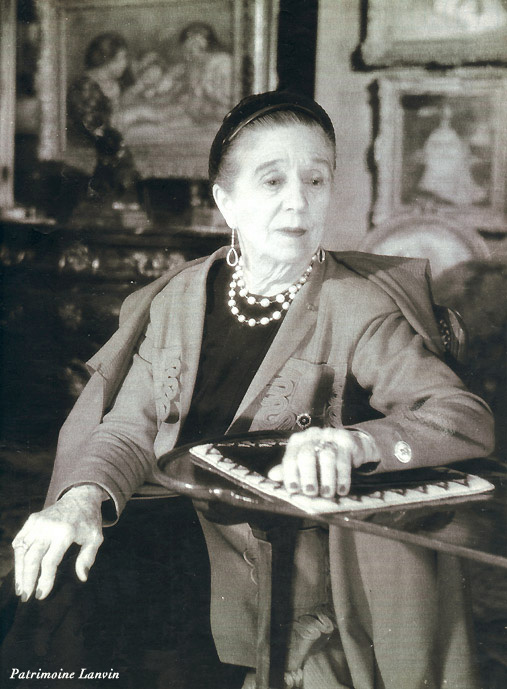
Jeanne Lanvin
Jeanne Lanvin was one of the most illustrious Paris couturieres of her time and the House of Lanvin continues to create beautiful clothing and accessories to this day.

From the Lanvin 2009 spring ready-to-wear collection

In addition to founding a fashion house, Jeanne Lanvin branched out into interior design and hired Armand-Albert Rateau to head "Lanvin Decoration". Rateau brought his skill as a prolific decorator, furniture maker and architect to Lanvin's house... quite literally.

"Arpege" by Lanvin

Rateau had already designed the bottle for Lanvin's Arpege perfume. Dedicated to Lanvin's daughter on her 30th birthday, the bottle design features a mother and daughter embracing.


Alcove sofa in solid oak, upholstered in tufted yellow silk, circa 1925

The pinnacle of Rateau's work for Lanvin was Mme Lanvin's Paris apartment, completed in 1928. Throughout, Rateau used her favourite, "Lanvin Blue," a soft, yet strong, cornflower shade of blue.


As well as her signature color, Rateau integrated other personal touches like featuring a strong daisy motif in reference to Lanvin's daughter, Marguerite (the French word for "daisy").

Bed alcove, circa 1922.
Detail of the bed alcove, carved and painted with gilt bronze handles, quilt and pillowcase in Lanvin Blue silk.
Lounge chair in painted beech wood, upholstered in tufted Lanvin Blue silk, circa 1925.

The bathroom Rateau designed is exceptional. A crisp mix of black and cream marble with mosaic floors and a hand carved pedestal sink reminiscent of ancient Rome.

Black, white and yellow Siena marble floor, yellow Siena marble pedestal sink, cast bronze hardware, circa 1924.
Bathtub in carved yellow Siena marble, alcove with gilded bas relief plaster decoration, circa 1924.

The cast bronze fixtures exemplify Rateau's superior skill in the medium.

Cast bronze fixtures, circa 1924.
Cast bronze lamp, circa 1924.
French Art Deco period chandelier in cast bronze in the style of Armand-Albert Rateau, circa 1920.

When Jeanne Lanvin's home was taken down in 1965, the complete decoration and furniture of the boudoir, bedroom and bathroom was given to the Musée des Arts Décoratifs by Prince Louis de Polignac where it is on view today.

For more information visit the Musée des Arts Décoratifs website.

Thursday, December 10, 2009

Studios La Victorine

Anouk Aimée on the set of "Bad Meetings" by Alexandre Astruc (1955)

Located in Nice, France, Studios La Victorine were part of the glamorous, would be, French Hollywood begun in the late 1920's. Founded by Serge Sandberg and Louis Nalpas, the studio had its ups and downs and certainly made its mark on French cinema.


Many silent films were filmed at the Victorine during the 1920's. When the "talkie" came to prominence, the Victorine was one of the few French movie studios which adapted to the new technology... and profited.

The prop department of Victorine Studios


Elaborate sets at Victorine Studios

After World War II, Victorine experienced yet another boom-time as many filmmakers, screenwriters and actors flocked to Nice. During this time, the studio was responsible for such films as "Les Enfants du Paradis" ("Children of Paradise") by Marcel Carné (1943), "To Catch a Thief" by Alfred Hitchcock (1955) and "And God Created Woman" starring Brigitte Bardot (1956).

"Les Enfants du Paradis" by Marcel Carné (1943)

Perhaps the most famous movie shot at Victorine was the classic "La Nuit Américaine" ("Day For Night") by François Truffaut (1972). Truffaut made this film, which revolves around filmmaking itself, in direct homage to the studio.

François Truffaut on the set of "La Nuit Américaine" (1972)

François Truffaut and Jacqueline Bisset on the set of "La Nuit Américaine"

In 1999, a new company, Euro Media, took over the studios and renamed them "Riviera Studios." Their ambitious plans may, however, be in trouble - the City of Nice owns the property and in 2018 will be able to sell it for development... a future which may limit any further investment in the property. Quel dommage...

Friday, December 4, 2009

The Illustrious SS Normandie

by Lauren Stewart-Ebert
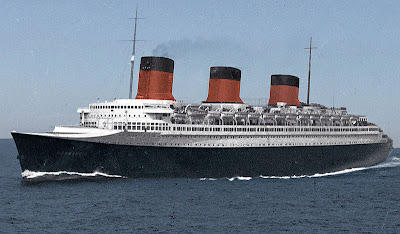
The SS Normandie

The SS Normandie was built in the early 1930's in Saint-Nazaire, France by the Compagnie Générale Transatlantique. She had a brief (yet fabulous) run...
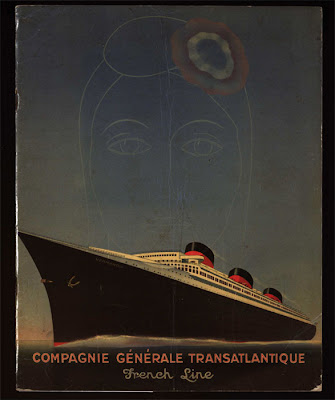

In the early 1920's, the United States tightened its immigration policies and the huge steamships which had been mainly devoted to transporting steerage-class passengers had to be replaced by more luxurious liners which could entice middle-class travelers instead.

The British White Star Line and the German Norddeutscher Lloyd were leading this superliner race, Compagnie Générale Transatlantique was not going to be left out. The French line was approached by a former ship architect for the Imperial Russian Navy, Vladimir Yourkevitch. His designs for the new ship were radically different from the status quo, the new ship was to feature a sharply slanted bow (more akin to a clipper than an ocean liner) and a slim hull.
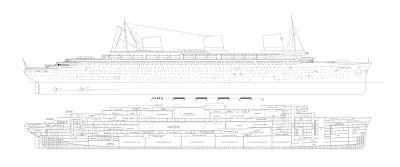
Side view and cutaway view of the SS Normandie

Soon after the stock market crash of 1929, construction began on the still unnamed ship. In the following years, Compagnie Générale Transatlantique had to ask the French government for loans to continue work (as did the White Star Line and Norddeutscher Lloyd of their respective governments).
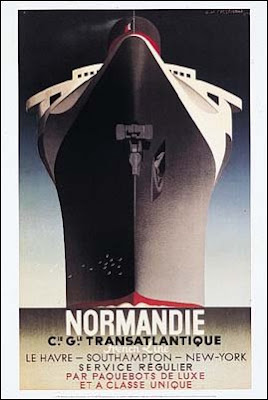

On October 29, 1932 the newly named Normandie was launched to a crowd of 200,000. However, the ship was only in a completed state on the exterior. Over the next three years, her interiors were outfitted and, finally, in May of 1935, she was ready for a test run.
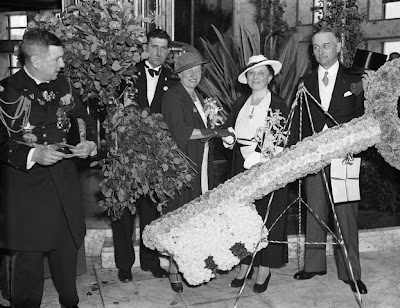
The launch of the SS Normandie

Yourkevitch's unique hull design was immediately noteworthy as barely a wave was created when the Normandie reached a top speed of nearly 60 miles per hour. In addition to the new hull shape, Normandie was filled with other new technical acheivements. She had turbo-electric engines, chosen for the their ability to allow full reverse power and an early form of radar (installed to identify other ships and icebergs).

The grand dining hall

The interiors of the Normandie were absolute marvels of Art Deco style. Perhaps the most dazzling feature of the ship was the first class dining room. Over three hundred feet long, forty six feet wide and twenty eight feet high, this was the largest room in any ocean liner. This dining room could accomodate 700 diners at a time and served the most sophisticated French cuisine of the period. Because there was no natural light, the designers illuminated the room with twelve foot tall pillars of Lalique glass and thirty-eight matching columns along the walls. This, along with the many exquisite chandeliers hung throughout the ship, earned the Normandie the nickname "Ship of Light."

"The History of Navigation", by Jean Dupas from the Normandie's first class salon

A mural by Jean Dupas decorated the Normandie's first class salon and the children's dining room was decorated by Jean de Brunhoff (creator of Babar the Elephant). The Normandie featured indoor and outdoor swimming pools, dog kennels, a chapel and a theatre.
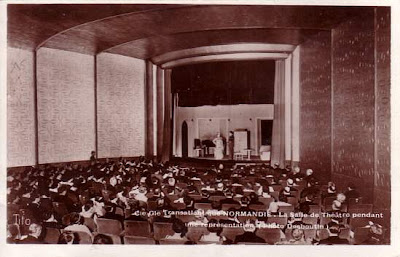
The theatre of the SS Normandie
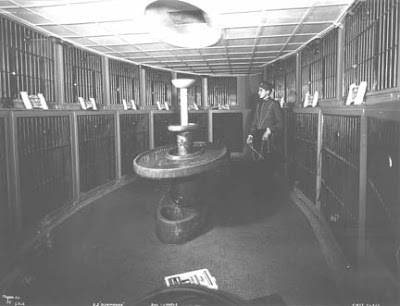
The kennels of the SS Normandie
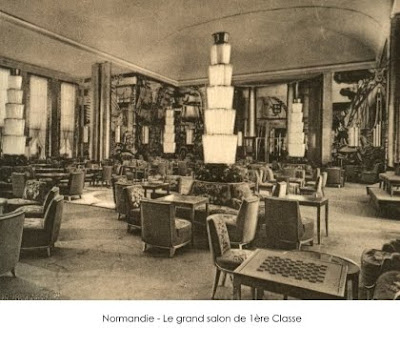
The grand salon of the SS Normandie

The maiden voyage of the Normandie took place on May 29, 1935 in Le Havre, France. 50,000 people watched as the boat steamed away. The Normandie reached New York City in only four days, three hours and fourteen minutes, setting a new record.

During her short but illustrious career, the Normandie carried a number of distinguished passengers including Ernest Hemingway, Noel Coward, Irving Berlin, Marlene Dietrich, Carey Grant, Walt Disney, Jimmy Stewart and the von Trapp family singers.
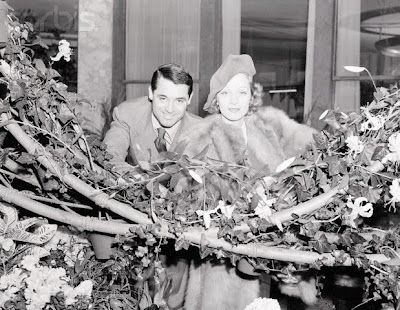
Cary Grant and Marlene Dietrich aboard the SS Normandie

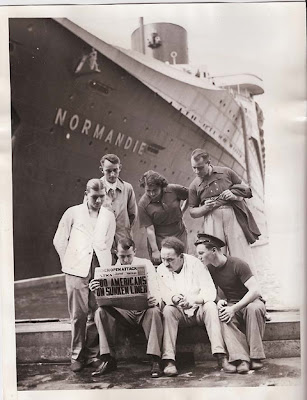
At the outbreak of World War II the Normandie was docked at New York Harbor. After France fell to the Germans in 1940, the United States seized the Normandie. By 1941, the U.S. Navy began converting the Normandie into a troopship to be renamed the USS Lafayette.

On February 9, 1942, sparks from a welding torch ignited a stack of life vests and the fire rapidly spread. Although the ship had a state-of-the-art fire prevention system, it had been deactivated during the refitting and New York City fire department's hoses did not fit the ship's French inlets.

The SS Normandie ablaze

The SS Normandie ablaze

Firefighters on shore attempted to douse the blaze, however, as the ship filled with water it developed a severe list and at 2:45 a.m. on February 10, 1942, the USS Lafayette capsized.
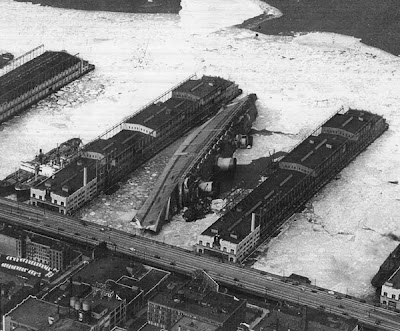
The capsized SS Normandie in the winter of 1942

Due to the exorbitant costs, the ship was not restored. In 1946, the Normandie was sold as scrap for a mere $161,680.

Many rescued items from the Normandie are still regarded as masterpieces of the Art Deco period and have been sold at auction since her demise, including the massive Lalique lights which adorned the dining hall, pieces of furniture by Jules Leleu and Andre Arbus and much of the crystal and silverware made especially for the ship.

A rosewood and velvet chaise lounge by Jules Leleu, commissioned for the SS Normandie circa 1935
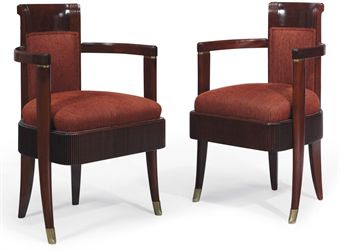
A pair of mahogany armchairs by Pierre Patout, commissioned for the SS Normandie circa 1934

Although the Normandie is no more, her presence is still felt. She influenced the designs of the Queen Mary 2 and Disney's matching cruise ships the Disney Magic and the Disney Wonder. The Normandie Hotel in San Juan, Puerto Rico was built as an homage the ship and the Miottel Museum located in Berkley, California has a large collection of Normandie memorabilia.
Thursday, July 9, 2009

The Château de Gourdon

by Lauren Stewart-Ebert


Located about thirty miles west of the French Mediterranean city of Nice is the small town of Gourdon. This medieval village is the home of the Château de Gourdon. Initially built as a fortress high on a rocky bluff during the Middle Ages, it has been transformed over the centuries into the spectacular castle (and museum) it is today.


Although the architecture dates to the 9th century, the interior holds a spectacular collection of Art Nouveau and Art Deco pieces in what is now the "Musée des Arts Décoratifs et de la Modernité".


The first floor of the museum houses one-of-a-kind pieces, both prototypes and personal creations by artists such as Jacques-Émile Ruhlmann, Alfons Mucha, and Louis Sue.


The "Tardieu Bed" was designed by Jacques-Émile Ruhlmann for the French Prime Minister, André Tardieu.


An office setting with pieces by Jacques-Émile Ruhlmann and Alfons Mucha.

The second floor of the castle is devoted to the Union of Modern Artists (U.A.M) and features the personal effects of Eileen Gray, Pierre Chareau, Francis Jourdain, and Jean Prouvé.


The personal bedroom of Eileen Gray, featuring her Bibendum chair and E-1027 side table.


A living space features a Jean Prouvé Cité armchair with ottoman.


A collection of armchairs designed by Pierre Chareau.


The Château de Gourdon also boasts a series of stunning gardens designed by André Le Nôtre, the renowned landscape architect responsible for the gardens of Versailles.


The perfectly manicured boxwoods in the Italian Terrace.


The Terrace of Honor with its shade trees and trimmed hedges.


This remarkable castle has survived through the ages and serves as a reflection on the decorative and architectural history of France.


For more information about the Château de Gourdon:
contact@chateau-gourdon.com
Telephone : +33 4 93 09 68 02
Fax : +33 4 93 09 68 97