"I would rather have built this little house than Saint Peter’s in Rome" — Frank Lloyd Wright
 |
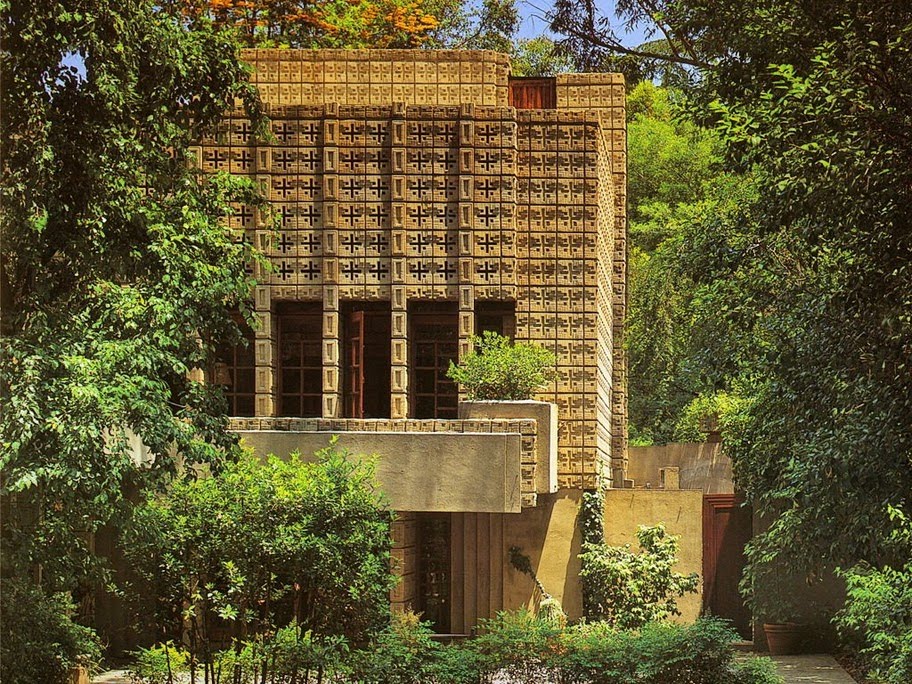
| The Millard House, "La Miniatura" |
Frank Lloyd Wright is undoubtedly one of the most well known and respected architects of the last hundred years. Best known for his development of the Prairie style house and, his masterpiece, the Solomon R. Guggenheim Museum in New York City, Wright's work includes many unique and innovative designs.
 |
| The Solomon R. Guggenheim Museum |
In the early 1920's Wright felt stuck as the "Prairie house architect" and sought to expand his architectural sphere. He began a series of textile-block houses in Los Angeles County.
 |
| Model for the Millard House |
 |
| Architectural drawings of the Millard House |
The textile-block houses were built of patterned concrete blocks. Not only did Wright want to develop a simple and inexpensive method of construction, he also wished to push himself into new territories by using concrete, "the cheapest (and ugliest) thing in the building world," to create a place of beauty.
 |
| The concrete blocks used to build the Millard House |
The first of these textile-block houses was the Millard House (also known as "La Miniatura" due to its relatively small size), commissioned by Alice Millard in 1923. Surrounded by trees and nestled against a steep ravine, Wright wanted to incorporate the house to its lush surroundings. To this end, he used sand, gravel and other minerals found on the property to make the concrete blocks.
Although the design was a departure from Wright's prior work, it was in line with his lifelong love of natural building materials and his belief that buildings should complement their surroundings.
The critical response to Wright's textile-block houses was unfavorable at first. The New York Times wrote, "It didn’t help that he was obsessed at the time with an untested and (supposedly) low-cost method of concrete-block construction. What kind of rich person, many wondered, would want to live in such a house?"
Over the years attitudes shifted profoundly and the Millard House has come to be regarded as one of Wright's finest works. As the Los Angeles Times wrote in 1965, "Environmentally, the place is fascinating because it still looks modern in a neighborhood that is gracious but aging. Or, maybe better, the Millard house is of no time and its own place."